 DRESSOURCE®
Bangladesh LDC Graduation Extended to 2029: What It Means for Your Apparel Sourcing
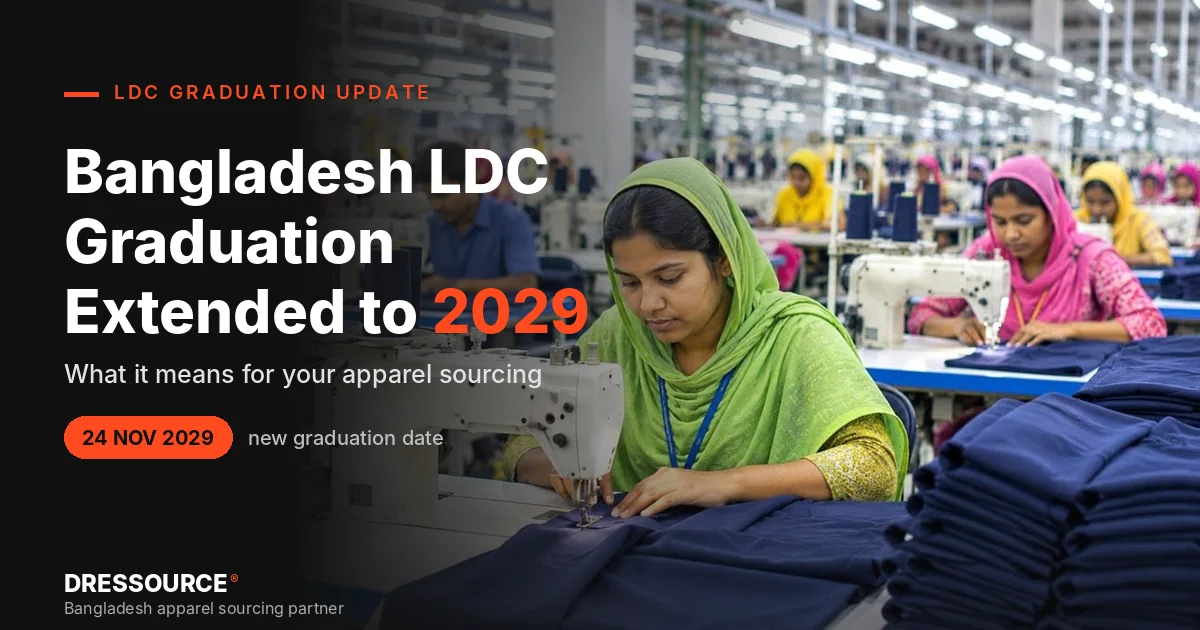
On 29 October 2026, the UN General Assembly extended Bangladesh's preparatory period for leaving the Least Developed Country (LDC) category from 24 November 2026 to 24 November 2029. Duty on your orders today does not change. The planning question is what happens after the new date: each destination market applies its own transition, and the EU's exact end date for Everything But Arms (EBA) has not yet been restated. DRESSOURCE helps buyers build duty-aware costing and origin records into production from the start.
- Bangladesh stays an LDC until 24 November 2029, so current preferences in the EU, UK, Canada, Australia and Japan continue.
- EU access under EBA is confirmed to at least the end of 2029; the rules point to about 2032, but that is not yet formally confirmed.
- Rules of origin and fabric records, not the headline date, protect a preference. Capture fabric origin in the tech pack now.
What the UN decided, and why
The General Assembly granted the extension on an exceptional basis. Bangladesh requested it on 18 February 2026, citing global economic uncertainty, geopolitical tension, energy and supply-chain risks and domestic challenges. Nepal received a parallel three-year extension.
| Date | Event |
|---|---|
| 1975 | Bangladesh enters the UN LDC list |
| 26 Feb 2021 | UN Committee for Development Policy (CDP) recommends graduation |
| 18 Feb 2026 | Bangladesh requests a three-year extension |
| 21 Jul 2026 | ECOSOC recommends the General Assembly approve it |
| 29 Oct 2026 | General Assembly adopts the resolution |
| 24 Nov 2029 | New graduation date |
What LDC status gives buyers
LDC is a UN category based on income, human development and economic vulnerability. Several importing markets give LDCs preferential, often zero, import duty.
What graduation ends
Eligibility for LDC-specific schemes, usually after a transition period that differs by market.
Why the extension has conditions
The CDP found Bangladesh exceeds the graduation thresholds on all three criteria, but its chair said significant domestic reforms are needed during the extra time.
What to treat as unproven
The government roadmap for 2026 to 2029 sets targets on banking, revenue, the business environment and factory energy security. These are targets, not delivered results.
The EU said the extension must be “accompanied by concrete, measurable domestic actions”.
Does the extension change duty on your orders?
Not today. Bangladesh remains an LDC until 24 November 2029, so current LDC preferences continue. The table shows what is reported for each market afterwards. Use it as a planning map and ask your customs broker to confirm the rate for your tariff line.
| Market | Scheme today | After graduation (reported) | What to verify |
|---|---|---|---|
| European Union | Everything But Arms (EBA): zero duty, no quota | Three-year EBA transition under Regulation (EU) 2026/1395, then GSP+, standard GSP or full MFN duty | Exact EBA end date; GSP+ outcome |
| United Kingdom | DCTS Comprehensive Preferences | Three-year transition, then Enhanced Preferences; UK officials say garment access is unchanged | Origin rules for your fabric |
| Canada | LDC Tariff | Three-year continuation reported; General Preferential Tariff reported to be extended with relaxed apparel origin rules | Post-transition rate for your tariff line |
| Australia | LDC preferences | Three-year continuation reported | Rate after the transition |
| Japan | LDC preferences | Tariff law revised to allow up to three years of preference after graduation | Rate after the transition |
| United States | No LDC-specific preference for Bangladesh apparel | No direct change attributable to LDC status | Current MFN and any additional duties in force at arrival |
EU: 2029 or about 2032?
You will see both dates, and they come from two different statements.
- Confirmed: the European Commission's guidance says Bangladesh keeps EBA at least until the end of 2029.
- Rule as written: Regulation (EU) 2026/1395, applying from 1 January 2027, removes a graduating country from EBA only after a three-year transition. Counted from the new graduation date, that points to roughly November 2032.
- Not yet done: the Commission's published guidance was written for the original 2026 date and has not been restated for Bangladesh since the UN decision.
Bangladesh keeps EBA preferences “at least until the end of 2029”.
Treat 2029 as the date you can rely on and 2032 as likely but unconfirmed. Do not price a contract on zero EU duty beyond 2029 without a fallback.
After the EU transition
- GSP+ is conditional. It requires implementing international conventions on human rights, labour, environment and governance, and the application must be accepted.
- Apparel faces a product threshold. Under standard GSP and GSP+, a product section loses preference when a country's share of GSP imports passes a threshold. Reported figures put the textiles-and-clothing threshold at 37% against a Bangladeshi share near 47%. EBA beneficiaries are exempt, so this applies only after EBA ends.
- MFN is the fallback. Several analyses cite an average EU MFN rate on apparel of about 12%, varying by product code. Vietnam, by contrast, is phasing its EU duties to zero under its trade agreement.
Bangladesh's government has said it wants a free trade agreement with the EU. Until one is signed, treat it as a possibility, not a planning input. For the wider picture by destination, see our duty guide by market.
Rules of origin: the technical change that matters first
Preference is not automatic. A garment must be originating in Bangladesh, and origin rules decide how much of the fabric and yarn chain must also be local.
Single transformation
Under EBA, apparel (HS chapters 61 and 62) can qualify when cutting and sewing happen in Bangladesh, even with imported fabric.
Double transformation
Under standard GSP and GSP+, yarn must become fabric, and fabric the garment, in the beneficiary country or an eligible partner.
UK Enhanced tier
The UK has reportedly moved the other way, allowing single transformation under its Enhanced Preferences.
Knit vs woven exposure
Woven exporters are widely reported to rely heavily on imported fabric; knit programs more often use locally knitted and dyed fabric. Woven programs bound for the EU after EBA carry more origin risk.
| Scheme | 1. Yarn | 2. Fabric | 3. Cutting & sewing |
|---|---|---|---|
| EU EBAsingle transformation | Can be imported | Can be imported | Must be done in Bangladesh |
| EU GSP / GSP+double transformation | Can be imported | Must be made from yarn in Bangladesh* | Must be done in Bangladesh |
| UK Enhanced tierreported | Can be imported | Can be imported | Must be done in Bangladesh |
The origin evidence chain
- 1Yarn & fabric purchase records per style
- 2Mill & dye-house delivery records
- 3Cutting & sewing records at the factory
- 4Invoice & packing list matching order and HS code
- 5Origin statement or certificate of origin
- 6Shipment documents
If step 1 is not captured at tech-pack stage, it is hard to reconstruct later. Our production workflow guide shows where each document fits in the cycle.
What it means for costing and sourcing plans
The risk depends on when goods arrive, not when you place the order.
| Goods arrive | EU, UK, Canada, Australia, Japan | Suggested approach |
|---|---|---|
| Through 24 Nov 2029 | LDC preferences continue | Normal costing; capture fabric origin data |
| Late 2029 to about 2032 | Transition periods apply; EU end date not formally restated | Cost a base case and a fallback case |
| After the transitions | Scheme and rate depend on GSP+, UK Enhanced tier and Canadian and other outcomes | Price duty as a variable; add a contract clause |
Landed-cost arithmetic
Landed cost per unit = FOB price + freight + insurance + duty + brokerage and handling, with import VAT recovered if you are VAT-registered. Customs value is defined differently by market (the EU and UK generally include freight and insurance), so ask your broker how duty is calculated for your destination.
As an illustration only, not a forecast: on a garment with a customs value of 10.00 and a 12% ad valorem duty, duty is 1.20 per unit before freight. At zero duty it stays 10.00. Build both lines into your costing sheet, or start with the cost calculator.
Practical checklist
- Confirm the HS code for each style (knit garments sit in chapter 61, woven in chapter 62).
- Record yarn and fabric origin in the BOM at tech-pack stage.
- Agree the incoterm (FOB or DDP) and who bears duty and customs clearance.
- For multi-year programs, add a clause on how price is handled if duty rules change.
- Ask the supplier which origin document is issued for your destination and who is responsible for it.
- Run costing at zero duty and at the MFN rate your broker confirms.
- Set review triggers: written EU confirmation of the EBA end date, a GSP+ decision, UK, Canada and Australia rules for your tariff line, and progress on any EU trade agreement.
Should you diversify?
Not because of this announcement alone. Bangladesh keeps its duty advantage in most major markets through the new date, and the right answer depends on category, volume, lead time and fabric origin. Use the extra time to compare landed cost with and without preference for your own styles, and consider a second source for concentration risk, not as a reaction to a headline. Competitors such as Vietnam already hold EU trade-agreement terms, so compare on landed cost, not labels. Our Bangladesh vs China, India and Vietnam comparison covers quality and capability.
Other factors to monitor
Tariffs are not the only variable. The government roadmap flags uninterrupted gas and electricity for export-oriented factories, banking and revenue reforms and faster approvals. Energy reliability and logistics affect lead-time confidence, so ask suppliers how they handle power and shipment scheduling rather than assuming either way.
How DRESSOURCE supports buyers through the transition
DRESSOURCE is a Bangladesh apparel sourcing and production-management partner that coordinates production through audited partner factories, from tech pack to shipment. For buyers planning around this change, the useful parts are:
- Duty-aware product development: tech packs and BOMs that record fabric and trim origin from the start.
- Fabric and trim sourcing: supplier selection with traceability in mind.
- Sampling and costing: estimates built with your destination market and incoterm in view.
- Production management and QC: in-line checks and AQL-based final inspection.
- Export support: commercial invoice, packing list and origin documentation with each shipment, plus freight coordination.
DRESSOURCE does not give customs or legal advice, so confirm duty rates and origin requirements with your customs broker. Looking for a partner to vet? See how to find and vet a garment factory or buying house in Dhaka.
Frequently Asked Questions (FAQs)
When is Bangladesh's LDC graduation now?
24 November 2029, following the three-year extension adopted by the UN General Assembly on 29 October 2026.
Does Bangladesh still have duty-free access to the EU?
Yes. Bangladesh remains an LDC, so Everything But Arms (EBA) continues. The European Commission has confirmed it at least until the end of 2029.
Will Bangladeshi garments face EU duty after 2029?
Not necessarily. Regulation (EU) 2026/1395 sets a three-year transition after graduation, which points to about 2032, but the Commission has not restated the exact end date for Bangladesh. After that, the rate depends on GSP+, standard GSP or MFN outcomes.
Is the graduation date the end of duty-free access?
No. In the EU, UK, Canada, Australia and Japan, reported transition periods run after graduation, so preferences continue beyond the date itself.
What happens in the UK?
UK officials say there is a three-year transition and then Enhanced Preferences, under which garment access is unchanged.
Does this affect orders shipped to the US?
LDC status does not give Bangladesh a US preference, so US duty depends on the MFN schedule and any additional tariffs in force when goods arrive.
What is double transformation?
A rule requiring yarn to become fabric, and fabric to become the garment, in the beneficiary country for apparel to qualify under certain schemes such as standard GSP and GSP+.
Should I move orders out of Bangladesh because of this?
Not because of this alone. Compare landed cost with and without preference for your own styles, and consider a second source to spread risk.
How to read the numbers. Duty rates, thresholds and dates are reported figures checked on 24 November 2026; trade schemes change and this article is not legal or customs advice. Prices, savings and lead times are indicative planning ranges, not quotations. DRESSOURCE programs start from 50 pieces per style; final MOQ, price and lead time are confirmed per project. DRESSOURCE coordinates production through audited partner factories in Bangladesh. Get a project estimate with the cost calculator.
Sources
- Regulation (EU) 2026/1395, EUR-Lex
- European Commission, Access2Markets: renewed GSP scheme
- EU GSP Hub: Everything But Arms
- UN DESA: Bangladesh graduation impact summary
- BSS: UN General Assembly decision
- The Business Standard: EU end-date analysis
- The Daily Star: UK position (British High Commission)
Ready to quote this product?
Send a tech pack, reference image or idea, plus your destination market and target ship date. Final quotation is reviewed within 24 business hours.